Thursday, November 10, 2016

Mark & Joe's Yamaha CA-2010 Integrated Restoration

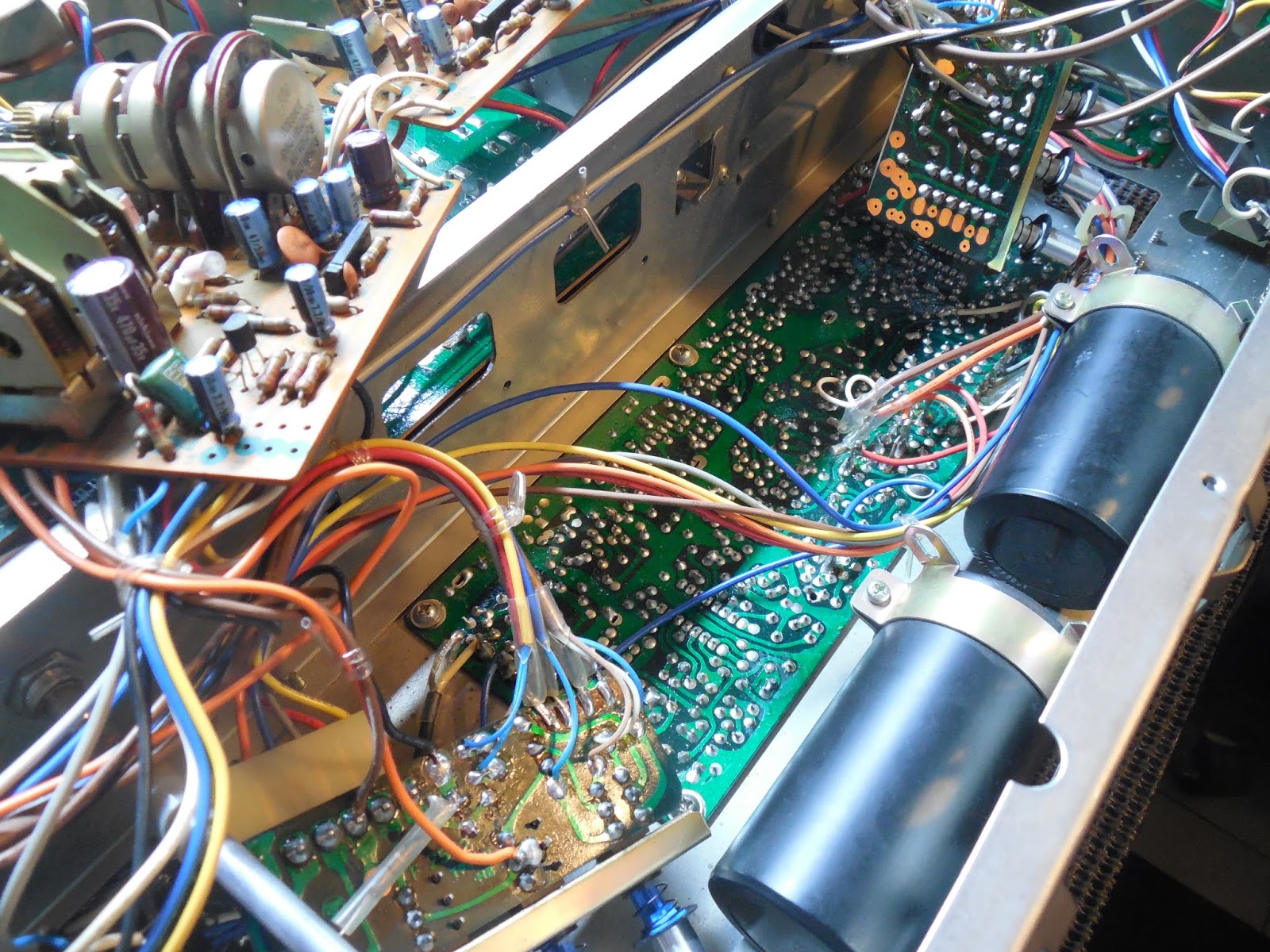
Two Yamaha CA-2010 Integrated Amplifier's


Today were featuring two Yamaha CA-2010 Integrated Amplifier for two customers. The CA-2010 is considering one of the best integrated amplifiers from Yamaha. A step above its smaller CA-1010 brother the CA-2010 was manufactured during the late 70’s (1978-79) touting an impressive 120W/CH @ 0.005% THD with a switchable Class A operation with decreased output.


The CA-2010 used a high grade stepped, enclosed Alps potentiometer, dual controls, low noise RIAA EQ FET’s with a robust 22,000MFD filtering stage versus 18,000 for the 1010. The build quality is very good along with the original component selection, the RIAA is a bit over designed and the issue with Class A operation are discussed below.


Power Supply/Protection NA06878
The CA-2010 uses a special relay both for the audio muting inrush circuit and protection relay (12V DPDT 10A) device that was replaced with a new Panasonic HL2 type.  The Main filter capacitors for the coupled/rail stages were replaced with computer grade 22,000MFD 100V Cornell filter capacitors along with the associated relay and safety capacitors with X1Y2 Safety type.


The electrolytic capacitors with replaced with a higher operating voltage high temp (105C) Nichicon PW capacitors along with VP Nichicon’s for the Bi-Polar electrolytic’s. The two bypass .1MFD films were replaced with high grade polypropylene ECW Panasonic’s.  The heatsink mounted TO-220 devices exhibit a large amount of radiant heat evident on the PCB assembly. Both of these regulating devices were replaced with a more robust, heavy rating On-Semi TO-220 devices with new thermal compound along with the diode network to new Ultra-Fast UF400# type.


BEFORE


AFTER


Meter PCB NA06836 & LED Modification
The meter control allows for a accurate and reliable peak to peak indications due to the ultra-responsive circuit calibrating input (mv) decibels and output (Wattage.)  This assembly also uses a common JFET the 2SK30A  and a proprietary PM-02 control IC.


The electrolytic were replaced with two 47MFD low impedance high temp (105C) PW capacitors with an increase in operating voltages.


One of the major cosmetics upgrades for the CA series is LED meters, which give us a reliable, long term lighting solution with less current draw overall and almost no discernible heat. We’ve perfected the dispersion and flickering by adding an inline UF400# type diode with a 470MFD/35V filtering capacitor to reduce any flicker or surge. The LED’s turned our fantastic!
One of the units the customer had removed the blue filter, hence the white meters on one.


Tone Control NA06826-1
The tone control on the 2010 is hardwire as well the 45 degree mounted stepped Alps volume control.  One of my biggest concerns was the hardwired connections were used which greatly increased the risk of connections issues. The hardwired connection was removed and replaced with the x3 runs of silver wire (NOT CHEAP!) for a better long term solution. On this assembly the AF path film were upgraded to high grade MKP and ECW polypropylene film capacitors as well as the 47MFD electrolytic replaced with a audio grade Nichicon KT with an increase in operating voltages.


BEFORE


AFTER


Another thing we encountered now is the integrated of fussier type resistors, these have an average watt rating to fail as part of the fail safe. Im am not a fan of these components as they tend to drift substantially in rating and have poor audio characteristics.  Using an appropriate Ohms Law formula one can calculate the wattage and replaced with an appropriately rated carbon film type that still provide protection.  The formula consists of I(squared) X Resistors = P. This PCB used three each channel two 33OHM 85mA and a 47OHM 70mA; (0.0049)x47=.2303 W (1/4W resistors)


RIAA EQ NA06877
The CA-2010 features an adjustable input/impedance selection for either MM/MC setups.


 For the MC Amplifier front end audio grade KT and low impedance PW’s with a increased in voltages were installed replacing the original tantalums as well with a PW Nichicon (100MFD’s) for the standard RIAA EQ stage initial differential 2SK100 JFET are used.  As above mentioned the RIAA EQ stage uses an array of fusistor type resistors, again these were replaced with carbon film in the appropriate wattage (33OHM 85mA (.2384W), 390OHM 25mA (.2437W.) Input and coupling films were upgrading to a high grade polypropylene WIMA film capacitor’s.


RIAA Curve Response


Drivers NA06844
The driver stage of the CA-2010 features a unique option to operate in Class A SEPP operation rated at a lower distortion to 30Watts. After rebuilding dozens of CA’ units I have determine the distortion factors vs the cons are not worth operation. Using Class A operation runs the unit into uncontrollable heating issues stressing several stages of the design. I DO NOT RECOMMEND operating these in Class A operation simply due to the extremely excessive heat within the driver stage.

BEFORE


AFTER


Again like the AF boards so far the drivers feature an array of fusistors which were all replaced with appropriately rated carbon film KOA type with a noted increase to 1/2W for the 68OHM/85mA (.4913W) resistor.

FR301/302 (4.7/230mA) 4.7ohm 1/4W  (4.47 und 4.35) (.2486 W dissipation) 
FR303 (100/50mA)  100ohm 1/4W (100.91)  (.25 W dissipation) 
FR304 (68/85mA)    68ohm   1/2W (68)      (.4913)
FR305 (390/25mA)  390ohm 1/4W+ (393) (.2873 W dissipation) 
FR306 (47/70mA)  47ohm 1/4W  (47) (.2303 W dissipation) 


The CA2010 driver features x4 1/80V capacitors which were all replaced with a high temp(105C) Nichicon with an increase to 100V rating. The input 0.1 films were upgraded to a MKP polypropylene film capacitor’s.  All of the Bias/Class A bias/ offset potentiometers were replaced with a precision Bourns trimmers. The differential stage consisting of a NPN and JFET array, the NPN differentials were replaced with a 1% matched TO-92 low noise modern transistors along with the end stage driver compliments to a more rubust, heavy duty MJE On-Semi TO-220 device with new thermal compound applied along with the TO-3 output devices. 


Audio Notizen **Watch for the Class A Report Update 11/16


Wednesday, November 2, 2016

Wade +1 Two Sansui 9090 Restore

Sansui 9090 Receiver


Today were are showcasing two Sansui 9090 receivers.  The 9090 is the little brother to the 9090db series abd larger brother with 110W output compared to the 8080 Sansui we featured a few months ago on a restoration. The other major difference between the db and 9090 is the output topology; the 9090 features a NPN quasi complimentary stage where as the DB features a fully complimentary output.
Sansui 8080 Restoration by Hallo-Fi 


One of the units came in would not power up initially due to several issues including an arching power switch connection and blown output devices in one channel, the driver board exhibited serious thermal damage. Its extremely important when working on Sansui’s to do two things; remove the caustic glue, if you examine the heatsinks where it touches you can see how it oxidizes metal and eats away, now imagine the BJT legs, second the removal and updating of the fusible type resistors.


Power Supply F2546
Their are several different component configurations in the 9090 depending on the service date.  Each of these models were different, one incorporating the decoupling 4.7MFD BiPolar capacitors and one not.

The electrolytic capacitors were all replaced with high temp (105C) long life Nichicon PW capacitors with an increase in operating voltage. I also increase the 1000MFD capacitor to a 1500MFD 63V PW for increase filtering in the power supply stage. The BiPolars mentioned were replaced with Nichicon UVP capacitors. 


The regulating 2SD313 TO-220 transistors were upgraded to heavy duty modern On-Semi TO-220 devices with new thermal compound applied, each of the 2SC1211BJT’s were updated to a modern TO-92L transistor for better heat dissipation.  Each board contained a different package but similar blocking rectifier 10DC1/2 device which was replaced with a heavier duty modern MUR1620 type common cathode rectifier. 


**Version #2 replaces the .01 ceramic coupling with 4.7BP and route the output to separate pins


The 6800MFD capacitors were removed while working on the AF stages and replaced with new 6800MFD/71V capacitors with the grounding arrangement simplified.


Protection F2547 
The protection network on the 9090/9090DB always leaves me disappointed. If faults occur within the driver stage it CAN and WILL trick the protection and will fail, it simply is not fast enough or sensitive enough and short or redesigning it for a better option.


The protection has a few known issues, the meter network tends to break down and the glue used to fixate the pots gets into the wiper causing issues. Also a the 10 OHM inlet resistor is rated to low at 1/4W, this was replaced to a MOX 1/2W resistor along with the associated 4.7OHM fusible resistors to carbon film 1/2W KOA type. 

The three 10D1 and two 1S1555 type diodes were replaced with modern ultra-fast UF400# and general 4148 diodes. The original MY4 relay was replaced to the modern Low Noise Omron MY4 24V relays I’ve been incorporating as of late.  The BiPolar was replaced with a Nichicon UVP’s and polar PW low impedance capacitors with an increase in operating voltage. The 1MFD BP electrolytic was replaced with a high grade ECW Panasonic polypropylene film capacitor. Ive also noticed a trend in the set glue on the meter calibration potentiometers to become contaminated with the dried glue and disrupting the wipers, new precision Bourns potentiometers were added.


Tone AF Stages F2544 & F2543
The F2544 uses a common pre-amplifier IC BA312 for a nominal NPN differential gain stage, a component you’ll be reading more on in upcoming restorations as we work on a side project *hint)


Its best to open-book these assemblies out of the chassis, this gives you access to the two switching PCB’s as well. Their are X3 electrolytic located on these two assemblies, which were replaced with  audio grade and low impedance Nichicon capacitors with an increase in operating voltage for longer life. 


Both stages incorporate a 2SC1313 NPN which were replaced with a modern low noise type TO-92 transistors.  The input electrolytic were replaced with a audio grade WIMA polypropylene film capacitor. Remaining 100>MFD capacitors were replaced with audio grade KT Nichicons and higher capacity electrolytic with low impedance long life Nichicon PW’s with an increase in voltages.


RIAA EQ F2541 & LAMP MOD
The 9090 features a very responsive and linear RIAA stage with minimal redundancy or feedback. Like the above AF stage, the RIAA uses a BA312 per channel for a differential gain stage. Below is also the RIAA Curve Response report I compiled on the units.


The electrolytic in this stage were updated to modern low impedance Nichicon PW’s with an increase in operating voltages. The 1MFD capacitors were updated with high grade WIMA polypropylene film capacitors. 


RIAA Curve Response


Driver PCB F2463
As mentioned one of the units had serious damage noted on the driver board, half due to the nature of how fusible resistors fail. They typically allow cascade current to destroys components in each direction of the line from the fault. Due to the severity of the damage and PCB tracing damage this entire assembly had all of the resistors replaced with 1/4-2W KOA carbon film and MOX resistors. The other unit has all its fusible resistors removed and replaced with 1/2W carbon film KOA type resistors. As noted below I tried several version of input films and matched both potentiometers sets on the two units with a different bourns precision type.

BEFORE


AFTER


Also noted was driver/predriver and the servo-bias transistors all of which were damaged. The 2SC948 servo bias transistors is a very accurate device but finding a cross-reference was not easy. AK mentions some devices but they only work at best, I have found a high enough Ft and HFe class device that works incredibly well in a TO-92 package. The original heatsink mount for the TO-1 2SC948 was used as thermally coupling this is critical! 


*Close up of servo-bias thermal transistor modification


The differential pair transistors were all replaced with a low noise modern Fairchild device matched within 1%. The complimentary  pre-drivers were replaced with modern low noise audio application TO-126 devices for better dissipation. The complimentary driver stage devices were all updated to a modern heavy duty On-Semi device with new thermal compound applied.  New 100MFD/100V Nichicon PW and UVP 100V/25V BP elecotrlytics were installed with an increased operating voltage. The input and coupling films and electrolytic were all updated to MKP polypropylene and WIMA polypropylenes. At first I tried out all WIMA but found as is true in most cases, the MKP/WIMA had a better result. Lastly new precision Bourns bias/offset potentiometers were installed and 2473 type diodes and the epoxy diode VD1212 replaced with modern 4148 type (series for VD type.)


*featured set of original outputs in unit#1 getting new compound


RF Stage and RF PS F2431
The RF stages for the AM/FM are housed on a single PCB other than the Front End which is extremely convenient.  The electrolytic were all replaced with low impedance long life PW’s and the 0.68MFD tantalum capacitors with a high temp (105C) KZ Nichicon.


The RF Power Supply is subject to significant heating issues from the large wire-wound resistors on board.  The regulating 2SD313 TO-220 was replaced with a heavy duty On-Semi TO-220 with new thermal compound applied. The x3 electrolytic were replaced with Nichicon PW high temp (105C) long life capacitors with higher voltage ratings as well as a new ultra-fast UF400# type diode for the 10DC1 original.


LED MOD and LAMPS
It is important to note the RIAA EQ assembly also houses the function switch. The function switch on the 9090 also piggy backs the AC lamp’s when switched into RF features. This passes too much voltage and destroys this gang. A simple wire modification at the molex terminals allows us to bypass the phenolic gang which is damaged from arching. This does however leave the dial lamps on at all times just like the 9090DB. With new modern LED’s this is not an issue.


The Meters are another failure prone area on the 9090 due to the poor construction of the original lamps, which basically corrode and break down at the lamp legs. Two LED’s are installed per Meter with the original fusible limiting resistors removed and updating to 47OHM 1/2W KOA resistors, LED in series.  The final product looks A++!


Audio Reports
**New Outputs Tested  MJE-TO-3