Thursday, March 19, 2015

Harman Kardon Three-Thirty Nocturne

Harman Kardon Three-Thirty "Nocturne

This is something special, the early first variant of the 330(A/B/C) family. It has a beautiful full black glass like faceplate on it with accented orange lettering. The green reminded me of a early McIntosh green.


Power Supply
The original rectification used an older to-220 SB/3 common cathode diode, I prefer to use the more reliable TO-220 MUR1620 common cathode diodes, their very robust and hold up well. They used additional .01 electrolytic axial that were replaced with a more suitable 450V+ Polyester ECQ film capacitor. Those old electrolytic axial I've noticed tend not to last like their radial counterparts.  The Mains filter capacitors were replaced with a nice low profile Nichicon KG.


The power supply uses several large Elna axial capacitors, which as I noted above tended to get dodgy over this amount of time. I chose Vishay 118 AHT as a high temp very long life supply capacitor. Their very well built and work excellent in filter/smoothing applications involved with a power supply.


Amplifier
The amp section uses a host of 4x filter 1000uf axial capacitors mounted top/bottom chassis, where I used a Nichicon TVX, another viable option maybe some Vishay atoms. All of the low value lyrics were replaced with a nice small uniform WIMA film capacitors, the original red mylar, as cool as it looked, was replaced with a Polypropylene ECW film capacitor and Elna Silmic II's. 


Pre-Amp (hi/low level) Stage
The pre-amplifier stage used in the Nocturne is very similar to the 330A/B pre-amp stage. All the 644 BJ-Transistors were upgrade to a little more reliable modern KSC1845 package.  Elna Silmic II's were exclusively used in this application.


Tuner PCB's
Again very similar layout to the A/B 330. Lately I've switched to a low impedance, long life,  high reliability Nichicon PW for the AM/FM circuits. 90% of the lyrics here were 1uf50V in the FM/AM. The tuning cap had acquired quite a bit of dust and derby that was cleaned as well.


All in all what a cool unit to work on, the only qualm is the quality of PCB they used. Another layer of seal on the foil side would help, along with PCB printing would have been nice. It cases like this its very important to make diagrams, photos and lots of notes! After using isopropyl alcohol to clean the foil side, heat transference seem to be a little better. Most of the old soldering I just removed and relaid to make sure its solid in something this old.


Tuesday, March 10, 2015

Sansui TU-717 Tuner

Sansui TU-717 AM/FM Stereo Tuner

Heres a Tu-717 Tuner that came in for a recap and cleaning. The TU-717 is considered to be one of the finest looking tuners Sasui offered, matching with its partner the AU-717 Integrated Amplifier. It also packs a 4/2 gang circuit for optimal pickup and reception. 


F-2681 Power Supply
The regulated power supply is fairly compact with only 12V rails.  All the lyrics here were replaced with Panasonic FR/FC high temp long life selections. The rectifier diodes were replaced with a  more robust fast acting 1n400#


F-2679 & F-2730 Cal & Discriminator
F-2679 & F-2730 the calibration and FM discriminator assemblies were recapped using nice Nichicon PWs which is a low impedance high reliability long life capacitor, I think these are excellent for just about any stage not in the audio path or power supply. All the bi-polars here were replaced with a Nichicon VP bi-polar lytic. F-2730 is housed on top of the inside chassis vertically through a molex pin connector and shielded from the main FM/AM assembly PCB. All the pin connected boards use a very nice, sturdy gold connectors, impressive, same as F-2679.


F-2680 Selector/Control  Assembly
The best way to work on this PCB is to remove it from the front chassis panel and remove the attached LED PCB assembly from the chassis as well, this allows you to pull the F-2680 assembly down and under the dial screen and out under the chassis. This really is safest, keep that iron away from any cords and give you full access to clean the switches as well. All the lyrics here were replaced with Silmic II's and Nichicon PW's. I do want to note that the SM states C25 is a 3.3uf lytic when its really a 6.8uf 50VDC. Also note C24 is a bi-polar lytic as well.


F-2678 Tuner Assembly
F-2678 is the main PCB assembly on the chassis. Whats nice is the open chassis and wide PCB make work on this board fairly straight forward. Lower value lyrics were replaced WIMA MKS2 film capacitor for a more reliable package, and as standard with tuner assemblies I use the Nichicon PW's again and silmic II's. All the diodes/zeners were replaced as well with ultra fast 4005 and a standard 4148's. The tuning capacitor was carefully cleaned and unit brought up to spec.


I haft say this is certainly one of the best sounding and looking tuners I've worked on short of say…the Marantz 150. 


Sunday, March 1, 2015

Marantz 2226 Receiver


Marantz 2226 Receiver 

This came in for a basic restoration from an AKer, was pretty damn dirty inside and the antenna was broken en route to me sadly so that harness was replaced as well.

Power Supply P800
This is a fairly typical regulated power supply found in the lower 22XX series. All the lyrics here were replaced with high temp, low impedance long life Panasonic FR/FC's. Q804 a common diode SIB0102 was replaced with an ultra fast 4005 variant. The rectifier diodes consisting of Q802 Common Cathode and Q801 Common Anode were replaced with a MUR1620 TO-220 I had on hand and a fabricated common cath.  The Main filter caps used to smooth the rectification stage were replaced with my favorite Panasonic THA's up'ed to 10Kuf which tends to increase the lower dynamic response range.  


PE01 Pre AMP
All the lower capatinence lyrics in the pass stages  were replaced with WIMA MKS2 films and FG and Silmic II's used throughout. This particular PCB uses quite a few of those orange fat originals films. Im a big proponent, like many that these are hard to beat and can make a significant perceived difference in the end product. I tend to keep them.  I like these easy access board, just remove from the front panel and your all set to go. I invert the assembly to properly clean the potentiometers. 


Phono/Control P400
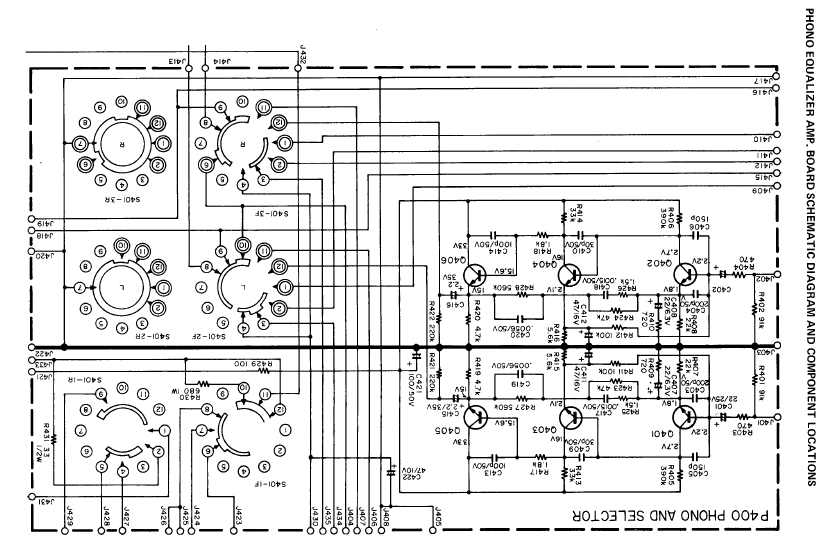
This is another Phono/Combo board with the selector mechanism on board. All the lower value lytics were replaced with a low impedance high reliability Nichicon PW. Silmic's were also used. If you note any noise potentials here I would recommend replacing the 2SC1318's with a NPN 1845 BJT. Don't forget CJ01 which was replaced with a 100uf 16V Panasonic FR. 


AMP P700
This is another symmetric single PCB assembly. I replaced all the lyrics here with nice Nichicon KZ Muse polars, Silmic II's and lower value lyrics with WIMA MKS2 films. I really like these huge robust pots, so if they adjust accurately and after a light cleaning I like to keep them in this case, the shallow circle design tend to get oxidized and drift, Bourns work well in that case.  Differential pairs consisting of a pair of 2SA722 transistors at the input stage. These were replaced with 992Fbu transistor pairs. It is absolutely critical to match Hfe gain in these pairs. 


The AM/FM and tuning cap section all share a same PCB assembly on this particular unit, which makes work fast. A simple recap of this section was all that was needed using primarily Nichicon PW for the standards and Silmics/FGs for the rest of signal path capacitors. Nows a great time to gently...ever so gently and carefully clean and lubricate the spindle/shaft of the tuning capacitor assembly. 


All in all, a nice easy open unit to work on. I really like the crisp clean sound from this lil' unit, the overhaul of the amplifier section really made a difference on this 2226, it is that much cleaner and pronounced. It also has that neat extra brushed aluminum bezel on the front plate you only see on a handful of models.


Monday, February 23, 2015

Marantz 2330 European


Marantz 2330 Euro Restoration

Heres another great 2330 that came in for just a basic restoration. This particular unit is a European variant which basically means it lacks the P600 Dolby integration along with the voltage conversion. 

As far as the 2300 I love to work on these units, the modular molex connections make for a fairly quick tear-down. The 2325 and 2330 are similar in the fact that the regulated supply (P800 is the same in both units, on occasion I have seen different relays though such as a my4 vs a dual throw. 


P800 Power Supply
The design of the relay circuit is interesting to say the least, one caveat is that the thermal breakers attached to the P700 assemblies are actually in series with the coils at J814/815 via the collectors of H806/807.

All the caps were replaced with long life, high temp Panasonic FR/FC's, the diodes and zeners I added are a little more robust with a ultra fast 4005 diode. Because of the extent of the glue, most BJT's and resistors along with the film were replaced as well, in the factory they really made a mess of this assembly. The common rectifiers were replaced with TO-220 packaged MUR1620 series and a new Omron MY2 relay added. the sinked transistors had the mica replaced with new compound added as well.


P400 Phono
The lyrics here were replaced with Elna Silmics and an axial packaged TVX Nichicon, as I usually do with smaller capacitance  values, WIMA MKS2 were used.  The smooth red films Im not a fan of were replaced with Panasonic polypropylene ECW films.  As a precursor the potentially problematic 405/406 transistors were replaced with ksc1845s and the rest of the glass diodes replaced with 4148's in series or singled. 


P700 Power Amplifier Assemblies
Per my usual all the lower value capacitance lyrics were replaced with Wima MKS2 and a Panasonic ECW PP films and Elna Silmic II's for the rest. I did use a nice MKP PP to replaced the film at 706 with excellent results I thought. I've tried a few other PP's in this application but I keep returning to MKP's. The differentials were replaced with new thermal compound sandwiched and heat-shrinked together. I really like these more robust heavy duty potentiometers for the dc and Bias personally. I think they beat the modern smaller Bourns unless they tend to drift or don't stabilize during adjustments I keep these type. 


PE01 Tone / Pre-Amp
All the BJT's here tend to be okay, but as a precusor while I was in I like to update them to some more reliable, in this case matched 992'1845's BJT's. All the tantalums were replaced with either Silmics or WIMA MKS2's. CE37/38 are a pair of bi-polar, I used some nice MUSE but any film would be great as well. The small gray films at CE05/06 were replaced with nice Panasonic ECW polypropylenes, I would like to try the MKP's here sometime.  I've tried Mundorfs in the same location in a 2325, but it wasn't anything to write home about. 


PH01 Buffer had the lyrics replaced with all Panasonic FR/FCs. And new 18K 100V Nichicon main filter capacitors were added. These were an exact drop in with the Z-bracket lining up perfect. A new switch with a Vishay X1Y2 and the unit was buttoned up. Should add, probably from removing the euro jack, but a power cord had been spliced with tape. Needless to say a new power cord and tap were added for safety reasons. Like the 2325, P700 as easy access BIAS test points added which makes it straight forward.


Again, the 2300 class has to be my favorite variant to work on and they sound phenomenal, plenty of headroom, great extension and aesthetics to match.


Saturday, February 14, 2015

Kenwood 600 Supreme Integrated Amplifier


Kenwood Model 600/650 Supreme Integrated Amplifier 

I was very excited to get a chance to finally work on one of these, one of Kenwoods TOTL integrated amplifiers, the 600 Supreme. Certainly has an interesting export history. 


The unit came in with an issue of going into protection, , as well as a restoration. The protection circuit and power supply/protection had been properly redone a while back so I skipped that after giving a run through.  I'll say this, the 600 is not for the faint of heart. To do any front panel pcb assemblies I had to completely remove all the switches/pots etc, and remove the chassis section. Same goes for removing the filter caps. Contrary to a few posts i've read, if the unit was put together correctly at the factory you must undo each power transformer to undo the cap mounting bracket. One thing to note is the amazing Alps pot, its a HUGE enclosed stepped attenuator design, extremely solid construction and action, it would costs high dollar to do better IMHO.


Pre-Amp 08-1560-10
This particular board was slightly different than the documented one in the service manual vs the standard X08-1470-01 PCB. All the lyrics were replaced with Silmic II's and lower rated  caps with WIMA MKS2's. This is an interesting pre-amp compared to a lot of Marantz I've seen consisting of 6 FET's for the 4-stage eq phase.  This particular board is a bear because of the tight shielded wiring thats rampant here.


Tone Control X11-1310-00
I used a lot of nice MKS2 films and Silmic II's and MUSE KZ, its a little tighter in here as well. The design is a class A ,FET based Peter Baxandall circuit.  Again it was easiest to remove the chassis mounts and panel hardware on this board than wrestle inside and potential break something. I much prefer to work outside the chassis anyhow.


Filter Assembly - X12-1130-10

When doing the tone control it was easiest to do the Filter Assembly  recap at that time, the boards sandwich each other. Again Silmic II's were used for any lytic. 


Power Amp X07-1440-00
The design is a direct-coupled design, it also incorporates the constant current type dual FET stage i've seen in other Kenwoods such as KA-8100, what is interesting is that it does not utilize an initial input coupling cap. The big issue on these boards are the differential pairs (2sa810) and, again, the constant current regulating (2sc1452). If you do your research you note that these heatsinked to-18 type transistors tend to be failure prone. I had one of the 2sc1452 failing not this unit, causing an intermitted protection issue.   Remember to match the hfe of the  KSA1381's used in the differentials.  Not a whole lot of lyrics on this board either, they were replaced with some nice Silmic II's and a single Panasonic ECW PP film  along with the main course and BIAS pots were replaced with multi turn Bourns. 

Before

After

Mind the different pin-outs of the new transistors (pictured below)


All four filter caps (18Kuf 75VDC) Chems were used, these are an exact drop in dimension wise, the screw terminal makes for fairly quick work after you add rungs. This is the first time I've tried these particular caps and they seem very solid, one of the filter caps I pulled had a nice big soft spot like a over ripened fruit on it.